Background
Textiles are believed to date from pre-historic times evidence of weaving being
traced to a period before 3000 B.C. The word textile refers to a filament or
yarn that can be made into fabric or cloth, resulting in the material or
textile. The word derives from the Latin 'textiles' originally meant only for
woven fabrics, but in later times came to include knitted, bonded, felted and
tufted fabrics as well.
Traditional handloom textiles began their long journey in the earliest
civilizations of India, China and Mesopotamia.
Cotton, silk, wool and flex fibre were produced in many regions of the world
and the skill and artistry of weaving occupied the imagination and dexterity of
those ancient peoples. Fine weaving probably passed from India to Assyria,
Egypt and Mesopotamia and
later to South Europe.
In the subcontinent textiles are hallowed by ritual and spiritual connotation.
In ancient philosophies the universe is envisioned as a fabric woven by the
gods. A whole range of mystic thought expressed in folklore and folk verse
compares the act of weaving, the laying of loom threads as warp and weft, as
creation. God is the weaver the fabric is man. The early Indus
Valley civilization, which is dated
from the Harappa and Mohenjodaro settlements
of 2600 B.C. do not provide visible evidence of the making of textiles, but the
find of a small shred of cotton cloth stuck to a pottery shard indicates that
weaving was part of craft production. Clay and metal seals from the Indus Valley
sites depict human figures clothed in shawl like draped garments and loincloths
held in position by woven belts and sashes. Historic events of the period from
3000 B.C. to 1800 B.C. analyzed by scholars and anthropologists reflect the
trade and cultural exchanges between the inhabitants of the Harrapan and
Mohenjodaro region and Babylonia (Mesopotamia).
Gold and copper, lead, lapis lazuli stone, turquoises, pearls, shell and bone,
fuchsite inlay and jade were probably traded for the products of the Indus
Valley settlers, such as cotton textiles, beads, copper tools, timber and
precious woods. The Indus (Harrapan) seals seen at Ur and other Mesopotamian
cities convincingly corroborate that sea trade between these two regions had
commenced as early as 2600 B.C. and continued up to 1800 B.C. Harrapan seals
used to seal bundles as merchandise, display cord or sacking (hessein)
impressions on the clay seals testify to different weaving techniques.
Mesopotamia trade documents, lists of goods and official inscriptions,
mentioned Meluhha, the ancient name for the Indus
region, thus supporting the archaeological finds of Harrapa and Mohenjodaro.
Spindles and spinning whorls have been excavated from the sites of the Indus Valley
while the cultivation of cotton and use of sheep's wool has been evidenced from
the implements found for processing these fibres. One can deduce that clothes
of simplified forms were in use, as seen in the terracotta and stone statuary
of figurines such as the Mother Goddess, dancing female and male figures of
priests and deities. The number of needles found at the Indus Valley
sites evidences that the technique of sewing was practised.
The Rig-Veda (1500 B.C.) contains literary references to dress, describing two
parts of the worn garment: the vasu (lower garment) and the adhivasa or upper
garments. Descriptions of different types of dress for various strata in
society are mentioned in the Rig-Veda, leading us to believe that clothes were
in use. A garment called atkal described as woven and well fitted is mentioned,
while a mantle or cloak called drapi is recorded. Female dancers used the
embroidered garment or pesas, and a bride wore the vadhuya at her marriage. The
taste for dressing was epitomized in the words suvasas and suvasana meaning
well clad. At the excavation sites of the Indus Valley
dyeing vats show that the art of fabric dyeing was known and widely used.
Certainly from the time of the Rig-Veda weaving and a variety of terms
describing different materials are used, such as vasas, vasana and vastra ;
words for woof and web 'otu', 'tantu' for yarns or threads and 'tantra' the
warp are found in Vedic texts.
It is at this point in history that cotton wool and cotton fibres from Vanga or
East Bengal are recorded as important trade
items and revenue earners. Marco Polo who traveled through many parts of Asia in 1290 A.D. gave accounts of the fine cotton
cultivation and its products. In India the manufacture of textile,
especially cotton had become a large industry, where enough was produced for
export. Indian cotton textiles continued to be the cynosure among royalty all
over Europe, the Middle East and India.
Muslin and Jamdani
The Indo-Gangetic civilization which grew and developed along the banks of the
mighty Ganga-Jamuna-Brahmaputra, fused into the indigenous culture of the
Bengal delta, to provide in an almost unbroken line the heritage we own today.
The renowned muslins of ancient Bengal, and the specialty of Dhaka muslin is
undoubtedly linked to the genre of the Dhaka weaver's skill and talent, or else
how could a loom craft come down over a period of two thousand years? The
delicate weaves of the diaphanous material and later the figured muslins or
jamdanis can only be explained by the unique inner quality of the Dhaka weavers and their descendants. Even today in the
villages of Naopara, Demra and Narayanganj, reside the offspring of these
blessed and gifted weavers, living along the same riverbanks and using the same
type of bamboo looms to weave their magic. Nowhere else in the subcontinent, or
elsewhere in the world, it is believed, has such fabric been woven by the hand
of man.
The weaving techniques of ancient Bengal,
which had been developed into a fine art, have come down to present times in a
more or less continuous form. The Greek Chronicler Mesgasthenes visited the
court of Chandragupta Maurya (Sandrocottus) in 325 B.C. and described the garb
of the Indians in the court as 'flowered robes of fine muslin'.
It can be said that the zenith of muslin production was achieved with the
patronage of the great Moghuls.
Italian traveller Manrique, in his writings of 1628, describes the patronage of
the court of Emperor Shahjahan, and later Emperor Aurangzeb, who received
annual tributes of these fine cloths from their Governors in Bengal
and which were so special that it cost ten times the price of any other clothes
made for Europeans or others in the Empire. We are informed further that muslin
merchants in 1887 protested the monopoly of the East India Company's hold on
weavers throughout East Bengal (48,000 persons) which was done by issuing
permits that prevented the weavers from taking on work for private traders.
It is the unique quality of the air at the particular point of conjunction,
where the river Sitalakhya branches off from the mighty Meghna. It is said that
the grey waters of the Meghna turn to a light yellow colour in the tributary
causing the air above it to hold a different dampness. The breezes that waft
from the river over the village on its banks (especially the morning air before
the sun rises high) give the weaver his `gift of the loom'. The weaver himself
is a unique being too. He kept his elementary links with nature. He held on
ritualistically to the rising at dawn to start weaving, the fixing of taana and
baana (arranging yarns in order) when breezes are light at different hours of
the day, the mode of weaving during the monsoon rains, the applying of starch
in the dry afternoon air and maintained seasonal time, the season to stop
weaving, fold up the looms and attend the village `melas' (trade fair). Even to
this day the weavers preserve habits and activities that conform to the rainy
season, stormy weather, and the dry winters, keeping their looms in tune with
the earth on which it stands. In fact, it is amazing that the shape and design
of the bamboo loom placed over a clay floor pit is unchanged over the past
centuries.
The other factor of vital importance to the uniqueness of Dhaka
muslin is the existence of the cotton fibre itself. In the India Office Library
in London is a manuscript entitled Textile
Fabrics by H.H. Cole, 1877, a catalogue made out in preparation for the Great
Exhibition in London
at that time. Under paragraph No. 335 it says, `The cotton of which fine Dacca
muslin are made is grown in the district and differs from the common cotton
plant of Bengal in some particulars, the most important being that the staple
of the cotton is longer, finer and softer. The finest qualities called the
photi, which have been cultivated from time immemorial in the districts, are
grown in certain localities along the banks of the Brahmaputra
and the Meghna. Its superiority has been attributed to the action of the sea,
the water of which, mixing with the rivers, which overflow their banks during
three months of the year, causes a deposit of silt and sand and this improves
and fertilizes the soil. The cotton in the state of kapas, that is, with the
seeds and wool unseparated, is cleansed and prepared by the women who spin the
yarn. The wool adhering to those seeds is carded with the jaw of the boali
fish, the teeth of which being small, curved and closely set, act as a fine
comb in removing the loose and coarse fibres of the cotton and all extraneous
earth or vegetable matter'
The combination of a special raw material in the cotton (kapas) produced in the
Dhaka region, the unique atmospheric temperature on the banks of the Meghna,
the innate skill of the Dhaka weaver, along with the aesthetic senses of the
Muslim patrons at Bengal's capital and the Delhi court, firmly established the
name and value of Dhaka muslins by the 16th century. The Dhaka muslins (as a
genre of woven loom cloth) were highly prized by this time and it is recorded
by Tavernier, historian-traveller from Italy, that the Iranian king Shah Safy
(1628-1641) was presented by his ambassador to India a muslin turban 30 yards
long, so fine that it could scarcely be felt when held in the hands.
By the 1800's English officials of the East India Company had made detailed
records of the loom manufacturing industry, acknowledging the masterpieces of
muslin production. James Taylor noted in his book that `A skein which a native
weaver measured in my presence in 1846 and which afterwards carefully weighed
proved to be in the proportion of upwards of 250 miles to the pound'. This
signifies the exquisiteness of the cotton yarn used to weave muslin. D.B. Mitra
also notes, `Many Europeans have noted the slender and somewhat delicate
physical frame of the natives of Dacca, the remarkably fine sense of touch and
the nice perception of weight which characterizes their fingers'. Regarding the
climate Mitra quotes that `The climate of Dacca
was well suited to the manufacture of fine muslins, while that of Birbhum to
the manufacture of coarse calico. The heat and climate of Dacca is lower by some degrees than that of
the western district of the province'. He also adds that `the reason why the
best weavers had settled in Dacca was that the finest
kind of cotton was cultivated in the neighborhood of Dacca', and later `the soil of Sonargaon,
Kapasia, and Junglebarry possessed all the components necessary for the best
cotton ground'.
It must be understood that mulmul, the plain white, striped and checked muslins
were produced since long on the Dhaka looms in different qualities for the
local populace and figured muslins or Jamdani were woven under order for the
richer classes. Hence the word 'Mulmul Khas' (special mulmul) and 'SarcareAle'
(the great ruler) were coined when mulmul was woven on order for royalty, but
mulmul was always a popular material for wearing comfort and beauty. Although
fine cottons were also produced at Mosalipotam in South India at this point in
time, Dhaka muslins exceeded in delicacy and
were far superior in texture, so as to become legendary.
For an accurate description of Jamdanis as observed by the British officials, I
quote from, 'Hand Woven Textiles of India.
"The famous malmal khas or 'King's muslin' could be made in lengths of 10
yards and one yard in width, containing from 1000 to 1800 threads in the
warp."
These could only be made during the rainy season, the moisture in the air
allowing the very fine thread to be woven, and would take a weaver almost five
months to complete. How rightly has Dr. Watson said, "With all our
machinery and wondrous appliances we have hitherto been unable to produce a
fabric which for fineness and utility can equal the woven air of Dacca. More beautiful
still are the figured muslinsthe jamdanis, from their complicated designs they
have always constituted the most expensive productions of the Dacca looms". The jamdani may be called
a product of the shuttle in which the designs are inserted by hand during the
process of weaving, and produce the effect of embroidery. As in tapestry
weaving, small bobbins or shuttles filled with coloured, gold or silver
threads, are passed through the warp, the weaver producing the exquisite
designs by the skilful use of the bobbins in the course of the intricate
weaving. No wonder the best jamdanis of old are today the prized heirlooms of
many a Bengali family.
The perfection of embellished muslins called jamdani took place through that
extraordinary coming together of three vital forces: material, talent and
patronage. The Muslim ruling classes with their Turko-Persian Central Asian
combine of sense and style placed a new demand on the weavers. The weavers
responded with imagination and dexterity, fulfilling the requirements of their
patrons. Persian influence takes dominance over design at this point in history
and the Islamic civilization's unique grasp of geometric and abstract motif
carries the craft of weaving to new heights. Without doubt it became clear that
the ethos, which springs from religious inspiration, led to an outburst of art
expression. The unique art of jamdani motif was thus born and gives proof to
the phrase 'divinely inspired expression' as creative weavers used their tools
to express their thoughts.
At this time also there is a noteworthy breakthrough in innovative design. A
distinct moving away from typical Hindu and indigenous motifs took place; the
lotus is evidently absent, while the rose, lily, star, sprig and arabesque
foliage take over. We also see the angular and geometric outlines taken from
glazed tiles, woolen carpet patterns and the enlarged blown-up paisley (kalka)
lifted from Kashmir shawls and Persian woven brocades. Designs from Turkish
leather saddles, tents (shamiana and kanats) and Muslim architectural lines,
bring vitality to the jamdani woven textile design.
As we seek to find the cause of the decline of muslin in the 18th century and
disappearance by the 19th century we find ample indicators pointing to the loss
of this rich cultural heritage. The debilitating actions by the colonizing
power had commenced a long while ago as learnt from G.C.M. Birdwood's record:
"In 1641 Manchester
cottons were still made of wool. But in vain did Manchester attempt to compete
on fair free trade principles with the printed calicoes of India, and gradually
India chintzes, were so generally worn in England, to the detriment of the
woolen and flaxen manufactures of the country, as to excite popular feeling
against them, and the Government yielding to the clamor passed the law in 1721
banning wearing of all printed calicoes whatever." The British policy to
protect its own textile manufacture led to a general stoppage of import of the
fine cottons including muslins from Dhaka.
Results of this policy became further obvious by 1793 and I quote, `British
policy British skill and British enterprise brought about a commercial
revolution, established a new economy and bound India to the heels of the British
economy' (N.K. Sinha, Economic History of Bengal, Vol-III)
Many factors caused the loss of one of the world's greatest living treasures.
The Dhaka muslin, which had been introduced into England between 1666-1670, had by
1787 begun to suffer the negative effects of the mechanized spinning and
weaving methods of British manufacture. The Company's trade to Europe,
particularly to Versailles, Hamburg
and Lisbon was badly affected by the wars England was waging against France. After
the French Revolution the demand of muslin cloths at the French court ceased.
Another important factor was the export of raw cotton to England, resulting in a severe scarcity of
cotton raw material in Bengal; the price of
cotton rose sharply leaving the weavers with no margin of profit on their
production. The Dhaka weavers who were employed full time in this occupation, became
unemployed due to the fall in exports of the finer qualities of mulmul or
muslin to Europe, America, Ceylon, Gulf of Persia and Arabia, Manila and China,
and the disappearance of Mughal patronage at the court, In the Dhaka arang in
1776 there were 1,600 weavers, but they were suffering under the oppressive
`advance loan' conditions of the Company's officials. Sonargaon which in 1833
had a population of 5,000 was the centre for manufacturing flowered muslins
(jamdanees) done mainly by Muslim weavers in the town and surrounding villages
and numbered about 1,300 weavers, according to the Company registers. The
coercive policies of the British through their `gamasters' and `amlas' had
begun to take its toll, and weavers had begun moving out of their profession
and tried to make a living out of their agricultural land.9 Writing in 1839
James Taylor in his book Topography and Statistics of Dacca noted that the
produce of the Dacca looms chiefly consisted of `flowered muslins (jamdanees)
and Khasidas (Kasida needle work on muslin) but the quantity was small compared
to what it was in former years'. Indeed the population of Dhaka declined as a
results of unemployment and D.B Mitra states in 'The Cotton Weavers of Bengal'
that `In 1800 the inhabitants on Dacca
were 20,00,000, but the total would not be more than 68,038 in 1839'.
In fact by the time of the first Great Exhibition of 1851, Dhaka muslins were
produced only on orders for the gentry and a small quantity for local markets,
as by then the export trade to England
had been completely overshadowed by machine made cheap cotton produced in Manchester.
Another interesting record at the India Office Library in London is the manuscript of the Colonial and
Indian Exhibition: Indian Catalogue 1886. Under the heading Bengal Div XIII,
loom embroidered fabrics, silk, cotton and woolen thread: sub section Nos. 239,
264, etc. it is recorded as follow: `From Dacca, loom worked jamdani pieces
both white and coloured, No 239 Shahburga chawal-dana piece lent by Nawab Ahsanullah
of Dacca ' This account indicated that the patronage of loom fabrics by the
Nawab family continued till very recent times, but the material referred to is
jamdani and not the old fine muslin. We may therefore deduce that there was no
high quality `Dacca muslin' produced after the 1890's since, by then, the
cultivation of cotton had been completely substituted by indigo and jute
plantations which the British rulers found a much more lucrative trade item.
The fabled muslin disappeared because the unique raw cotton was no longer
available. This fact can give culture activists a point to ponder, that if
cotton plantations are revived, the gifted Dhaka
weavers can still produce the muslin of old
Silk Weaving - The Dhaka Heritage
The heritage of woven handloom
silk in Bengal does not compare to the fine
cotton muslins in terms of historic or chronological
measurement. Silk textiles were available in the last few hundred years from China and other
parts of the Indian subcontinent and were used by the aristocracy and landed
classes for ceremonies, coronations and weddings. The use of silk for garments
has become more popular in the recent fifty years or so.
The post war migration of
weavers from Uttara Pradesh (U.P. India) to the new state of East Pakistan in
1946-47 transfers the growth of a rich heritage to the soil of East Bengal.
It would be useful to
recount the ancient lineage of weaving silk cloth, embellished with gold, and
silk threads. Woven silk is mentioned in the Yujur Veda of approximately 1500
B.C. Further back in history there are references that trading merchants
carried silks and cotton fabrics through the region of Middle, Central Asia and
further on to Italy and France.
Descriptions of the "gold cloth" of Babylon, Alexandria, Mosul and the
Gangetic Valley being carried as gifts to King Herod of Biblical times and the
Emperors of Europe is well substantiated in the exotic classical paintings of
that luxurious era. Descriptions of the clothes worn by aristocracy and priests
in the Mahabharat and Ramayana are replete with examples of "rich
silks". The yajur veda records the use of rupari and soneri threads to ornament the fabric and we
learn from these ancient manuscripts that special women weavers called
"pesaskaris" wove such material, being commissioned by the upper
classes. Moghul patronage in the crafts and arts of the subcontinent had made a
tremendous impact on the creative process. The silk brocades of Banaras came under this influence, of Persian design in
all its richness and grandeur, enhancing the weaver's repertoire. The Moghuls
were masters in giving nomenclatures to the artistic products of the local
artisans. The Persian language in itself is steeped in descriptive and
colourful words or motifs that charm the mind and heart of the viewer. Thus
they named Banaras brocades as "dream
fabrics" or Kinkwab.
European writers later on called these "Kincob" and indeed the gloss
and glimmer of the silk fabric created a dream like vision for the eyes. Over
the centuries Banaras silks became renowned
and the demand led to more centres being opened in other parts of the
subcontinent for trade and marketing. Ahmedabad, Auarangabad, Surat,
Bhopal, Delhi,
Luchnow, Murshidabad and Madras
set up weaving centres. The examples of the exquisite loom are hunting scenes
of extraordinary finesse depicted in a design named shikargarh. Men's robes, cloaks
and shawls had designs named "silver ripples", or maz-char, black motif on
off-white silk called "nightingales eyes" or 'bulbul chasm', the moon
and star motifchandtara and
linear patterns called peacock's neck or murgh-gala.
For ladies of the court were delicate motifs likebutidar or flowered patterns, beldar or scroll and vegetal creeper designs, hazarbuti thousand flowers and nargis the narcissus flower. It is
interesting to note that some motifs of Moghul textiles are echoed in the
fabrics seen in Ajanta fresco paintings of the 5th Century A.D. Traditional
indigenous Indian forms were also imbibed on to Benaras silks, so that we find
patterns of the swan motif (hangshs/hamsa) and the paisley shape called kalka of Bengal and keri of North India. Banaras Kinkhawabs were further evolved with the mixture
of two shades of silk threads giving the effect of light and shade, named dhup-chaon. This cloth was
greatly popular among aristocratic ladies who flaunted the changing colours of
their dress as they moved about in the daylight. The fame of Banaras
silks was duly documented as some of the unique exhibits. Descriptions detail
"a sari in yellow silk gauze with floral scrolls, the border and end piece
(anchal) being in thick silver checkered damask, separated by narrow red
lines with gold spots placed at intervals". Another exhibit was the
"diagonal pattern called tercha bearing stalks and foliage of the
scroll type, each composite flower of floret being outlined in gold
thread". An art connoisseur of the period Theopbile Gautier wrote about
the glory of Banaras brocades as "cloth,
which attempted a direct challenge to sunlight the accomplishment of millions
of fairies".
The culture of the
Indo-Gangetic plains has been nurtured by the mighty rivers Ganga
and Jamuna. The soft breezes blowing out from the rivers were conducive to
keeping the looms and the waft and weft of threads pliable. The romance of the
soft pure silks of Banaras had reached Bengal
with the advent of Moghul rule. By the 1920's the Banarasi sari became an
essential part of the Indian bridal trousseau. The item was supplied as part of
the exotic textiles from Uttar Pradesh,
India.
By the 1930s Dhaka set up its own Banaras Silk Industry Centre in
Becharam Dewry, in the old town. Sarees were priced at Rs. 150/- and a bridal
saree fetched a princely price of Rs. 400/-. The main market outlets were in
Sadarghat Market, Islampur of the old town and by the 1960s the posh newly
built New Market near Nilkhet.
One significant stimulus
was in the 1940's resulting from political changes, the movement for Independence from the
British and finally the desire for a separate homeland for Muslims. The result
of these factors brought about the migration of large populations from one
region of India
to another. Among the first few families who packed up their looms in 1946 and
came with high hopes to Dhaka to start a new
life was Mohammad Sobhan, father of Mohammad Rafiq whom I met in Mirpur Palli
in 2004. They belonged to Cholapur village
of Benaras. Some other
migrants were the father of Sanaullah Warsi (78 years) who still works at the
loom in Mirpur, Liaqat Ali (70 years) and Qayyum (65 years) whose parents reached
Dhaka in 1946. From these original inhabitants
of Benaras (whose second and third generation families are residents in
Mirpur), I was able to obtain valuable information on the weaving processes as
well as the names of original designs. Banarasi brocades were woven with the
help of jacquard system, depending on the skill of the weaver in line-by-line
placement of patterns on the taanaand baana. The paper drawing of the
designs would be the guide for the weaver, a matter of extraordinary skill of
eye and hand. The master craftsman of Mirpur informed me that silk brocades
carried names such as beldar, border designs, forms of creeper
design; belbuti, diagonal floral styles and satin-but, thickly embroidered motifs in silk
thread embossing. Classical motifs from the Persian storehouse of design were
known as jam-e-bahar (trellis patterns) and jam-e-var(Persian paisley) gul-dasta (bouquet or flower vase motif) also
referred to as ambros. An overall linear floral ornamentation was called jungala (foliage pattern).
As time passed Bengali
words came into use such as lata-pata (trellis) prianka (floral) tara-buti (star bud) kalka (paisley),moyur-pakhee (peacock), tiapakhee (parrot). In recent years the
influence of film and television media led to naming sari designs after
Titanic, Devdas, and Ghar Ghar Ki Kahani. The weavers of Mirpur Palli were
commissioned to produce the extravaganza of silk saris worn by Indian actress
Aishwarya Rai and her dance troupe in the film Devdas.
As is common with most
heritage crafts and arts produced in the subcontinent, the Banarasi loom is
composed of wooden, bamboo and small metal parts arranged in the earthen pit
floor of the Karkhana (factory). There has been no change in the loom since
over a thousand years, the only change has been the addition of the jacquard
introduced after 1947.
A brief description of the
process undertaken by the Mirpur weaver was explained by Mohammad Rafiq, a
leader among the weaver community and a second generation Banarasi weaver. His
wife Razia Sultana Parveen also from a weaver's family, is herself a skilled
weaver. However, none of their children have taken up the profession. All are
attending school and college.
The process of preparing
the threads for making saris is long and laborious. A brief description is
given below :
1. First high quality silk
threads are purchased at an approximate rate of Tk. 1,500 per kg imported from China, India,
Pakistan or Thailand. These
imported threads come in the form of bales and are put onto wood rollers.
2. From these smaller
lengths are cut and taken to spin spools on wooden charkas (wheels) for the baana (weft).
3. The larger spools, lachhis are then sent for dyeing. Special
dyeing experts, do this by immersing the threads in boiling pots of soap water
for at least one hour, before laying them out to dry. After boiling for over an
hour with at least 4 bars of soap in water for a length of two saris, the
bundle threads have to be washed in at least four pots of clean water mixed
with a thread softener called khararee (digamen).
4. The dyed spools are
put onto turai or beams, which look like large
rolling pins called belun.
5. The required lengths of
threads for the taana (warp) of one or two saries are
straightened out and joined if necessary to achieve the required length. The
silk threads are fine like hair and they are joined with a powder called madesun made from fine soft ashes (chhai).
6. Once the threads are
arranged for the taana, they are fitted at the weaver's end of
the loom by speciallsed craftsman, who are not the weavers. The taana-setter
knows before hand that the sari has three colours; for example the main ground
colour (jomeen) will be black, the border (paar) and end piece (anchol) will be beige and motifs will be
of cream shades. The weaver explains the design to the setter referring to
patterns such as keridar (paisley) or phoolkoli orkangeevaran. The exchange of information is all
verbal and there is no written code or guideline. The skills belong to the
craftsman.
7. The dyeing process is
fascinating, as 70 yards can be dyed at one time in three colours, for up to
five saris with blouse pieces. This is done by using one colour dye up to a
given measurement of the threads.
8. For the baana or weft, the loom setter uses the pareta a bamboo rolling pin also called natawa. The thread spools
already prepared by the charka workers are kept on the earthen
floor near the weaver.
Names of tools used to
weave Benaras silk brocades are as follows:
Turai / belun (roller-beam)
Khuta (side posts)
Karga (pit)
Lappa (horizontal wooden
rods)
Jacquard (cards perforated
with holes for lifting needed threads)
Phhana (bamboo read)
Makri (upper/roof suspended
rods)
Gulla or baw of natawa
bamboo/wood spool.
Tana (steel plate)
Rooler (wood roller)
Charka (hand spin or cycle wheel)
Khalli (iron rods rotated to tighten threads)
Charr or birni (thin wire used to tighten
threads).
Makku or dherki (five inch
long flat shuttle piece of buffalo horn used to push threads left or right as
needed.
Katha or shirki (wood or bamboo flat instrument used
to form floral patterns). Nowadays these are made of plastic.
Dhaka
has become a hub of a great heritage of craft of the subcontinent, the renowned
Banarasi brocaded silks. Today the far‑flung cousins from the lineage of Banaras weavers are carrying on the legacy in their
chosen homeland. The elders speak with nostalgia about their roots, but they
are aware of their contribution to the cultural wealth of Bangladesh. The
heritage is alive because public patronage is forthcoming and because the
weavers of the exotic art‑craft are dedicated to passing on the legacy for
posterity.
Tribal Textiles
Vanga or East Bengal had grown its townships, commerce and industries over the
period approximately of 1000 B.C. and the Indo-Gangetic Civilisation had
reached fruition, imbibing and fusing with the earlier Indus Valley
culture.
The Bengali race is a mixture of Mongoloid, Arakanese, Burmese and Assamese
peoples with the Aboriginal river, forest and agro-based peoples of old Vanga.
The most recent entry of outsiders started in the 8th century A.D. (up to the
12th century) when Buddhist influence was at its height and the great
monasteries at Paharpur and Mainamati testify to that influence. The Pala and
Sena Dynasty overcame Buddhism and its followers sought safety in the hilly
regions of Rangamati, Bandarban, Khagrachari etc. They form some interesting
Tribal population of the country.
The Tribals of the Chittagong Hill Tracts consist of ten main tribes, belonging
to the Chakma, Tripura, Tonchangya, Roeng, Pangue, Tusha, Moru, Khumi, Chak and
Khyeyng. Several, but not all of these tribes had a weaving tradition. The
Chakmas, an important tribe, who follow Buddhism, produce handloom cloth, which
carries an ancient link with tribal or indigenous communities in larger Asia. Weaving in Buddhist tradition holds spiritual and
ritualistic overtones. In fact some textiles are considered as sacred, such as
those woven to commemorate the death of a person and also those woven for marriage
ceremonies. There is a special cloth made of hand spun yarn and woven specially
as an act of charity. Such long pieces of fabric are made by Chakma women and
hung out in open spaces or forest areas on a tall bamboo, as a gift to the
monks. Buddhist monks eat from charity (they do not cook their own food) and
also they cannot purchase their garments. They receive gifts of their robes
from the community, who hang the material in the open, and any monk whose
clothes have worn out can cut off a piece to fulfill the needs of his apparel.
The weaving of material for
charity in olden times was a religious act, and the raw materials were made of
handspun cotton thread, natural dyes. Ritual prayers are offered at the time of
weaving.
The Chakma Loom:
The most well known loom is
called Baen. It has twelve main parts, nearly
all made from bamboo and the chhaw betal nut tree. The parts are as
follows:
Biyong, Bau Kati - heel
section, Shaugtia bach, Siyang - to keep threads uniform, Tammo bach - beam,
Tagalog - beam, Leblebi - heel to set threads of taana, Thur Sama - shuttle of
bamboo, Charka - spinning wheel, Chorki - for spinningjhoom threads, Tarchi Cam - Waist belt (of
buffalo hide), Rope - for belt and Tarchidori.
Names of Designs :
Every Chakma girl is taught
weaving by her mother and elders. The skill is considered a qualification of a
good wife and mother and a spiritual value is given to the art of weaving.
At about eight years of age
a girl is encouraged to start learning a range of designs, which her mother
shows her from an heir-loom woven catalogue. This is called the aalum.
There are hundreds of patterns but a good weaver must learn. Some of the most
famous designs are:
1. Begum bichi - seed of eggplant.
2. Teen beya -
three sticks used to hold threads.
3. Kanjal -
snake curve.
4. Bangal
Chabugi - small flower.
5. Bago choke -
tiger's eye.
6. Chori phool
- design on clay water pot.
7. Anaj -
pineapple.
8. Tuptupi -
aat-bo-lizard's foot.
9. Bourgogaw -
like Bangla alphabet letter.
10. Padi cabang gach - king
of design.
11. Aza thang - ducks
feet.
12. Chaba Kangel -
snake twist.
13. Satacrang - small
wild marigold.
14. Thengbala satarang
- combined pattern.
15. Majara - cane stool design.
16. Kangara - crab.
17. Sath beya karanga
kapya - seven stick.
18. Daush beya - 10
sticks.
Stick counts refer to the number of small sticks inserted in the threads to
form the motif. They go up from sixteen to thirty-eight lines in a single
pattern. These form the complicated geometric designs of Chakma loom fabric.
Recent changes have
occurred in the textural quality of Chakma handloom fabrics, with the entry of
rayon, machine made threads and gold zari threads. Traditional jhoom handspun yarn has been replaced by
Korean cotton yearn. Now dyeing is done with chemical dyes, and the range has
therefore increased. Previously red, black, dark green and white were the main
colours. Renowned weaver Mrs. Panchatala Khisa who pioneered the craft of
weaving tribal textiles for themarket, says she is optimistic regarding the
increase of handloom production. She says, "If we move with the times,
Chakma tribal textiles have a bright future. Not only do our tribal women feel
proud to wear our own dress, but by producing the material for shalwar-kameez,
men's fatua, shawls, skirts, waist coats, caps etc. we are attracting the
general buyers. There is a growing interest in tribal loom cloth. It is up to
us to meet that demand".
Manjulika Chakma, the apt
daughter of Panchalata Khisha, is also a winner of many national and
international awards for her thirty years of dedication to the preservation and
development of Chakma tribal textiles. In 1960s and 70s there was no market,
but her determination has given recognition to a great heritage and kept it
alive. Now there are at least twenty-five loom factories, engaging two thousand
workers in the hill tract region. Manjulika Chakma opened the
first commercial sales outlet in the 1960's. Tribal women are presently
marketing their products in the local'haat', or as vendors going
house-to-house creating a new activity of profit for tribal women. With
increased demand, Manjulika Chakma mentioned that she markets some of her
production through agents. She believes that the future of woven material
produced by the tribal people is undoubtedly bright.

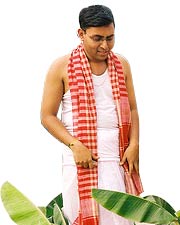 Gamchha is a traditional Indian towel made up of thin coarse cotton fabric. Although it is normally used for drying one's body after bathing, gamcha serves other purposes also. It forms an important item of men's clothing, especially of those belonging to the lower sections of the Indian society. For instance, one often sees physical laborers, like coolies, construction workers and farmers, carrying a gamcha on their shoulders.
